The ‘Normal People’ Effect

The ‘Normal People’ Effect

***This blog post was originally written by me for Matriarch, published in December 2020***

“Most people go through their whole lives, without ever really feeling that close with anyone.” 

It was April, we were deep in lockdown, and I found myself, along with the rest of our generation, mesmerised by the love story of Connell and Marianne. I was glued to the TV and I thought about the two characters all day long. Every once in a while a TV show like this one comes around; a show talked about so much that it’s far more time consuming to avoid it, than to give in to its binge-worthy charms. Of course, often behind a great show, lies an even greater novel. I had been recommended Rooney’s Normal People by a friend back in February, but all I had done was add it to the mental reading list inside my head. Having now devoured its pages, I am kicking myself that I wasn’t one of those people who could smugly say ‘I read the book before the show came out.’ Nonetheless, I think the viewing and reading go hand in hand – you would be foolish to not do both. 

Sally Rooney was just 26 when her debut novel Conversations with Friends was published, and 27 when Normal People came out in 2018. From her age, there is no doubting how she was able to so perfectly capture contemporary teenage life in Connell and Marianne. Her words felt like they were the missing piece of young adult fiction, and I feel as though I truly learnt something from Normal People

Let’s start with the characters: Connell. I was incredibly moved by the depiction of Connell’s anxiety and how it affected every decision he made. I have never read such an accurate representation of anxiety of people in their late teens and early 20s, and I only wish I had been able to read this book when I was 18 years old and confused at how so much seemed to be changing around me. In the limited series, a lot of what we see are Connell’s physical expressions of anxiety and depression; the panic attacks, the crying and often the inability to express his feelings coherently. In the novel, we are able to follow his thought patterns which only make the former descriptions more impactful. Rooney gave us a popular teenage boy who was really suffering on the inside, and it goes to show that what you see on the outside is only half the story. As someone who really struggled in my first year at university, I was able to empathise so strongly with Connell and it reminded me that so many people don’t talk about ‘not fitting in’ because they assume everyone else has. 

Marianne. A lonely girl who was simultaneously confident and extremely insecure. Rooney managed to perfectly blur the line between the two in this case. Marianne was headstrong but we were also able to see how much her childhood and upbringing had affected the way she viewed her position in the world. I think this is why she spends so much of the novel doubting her own self-worth and was constantly looking to others to value it for her. What I loved about her character was that she never tried to conceal her intelligence – she was unapologetic and opinionated, which is something that people so often, and wrongly, feel threatened by. Despite the lack of love at home, Marianne was still able to offer her heart to those who deserved it, even when she felt like she didn’t deserve it herself. Although it took her a long time, she eventually understood that just because someone is damaged, it doesn’t mean that they are not worthy of love. 
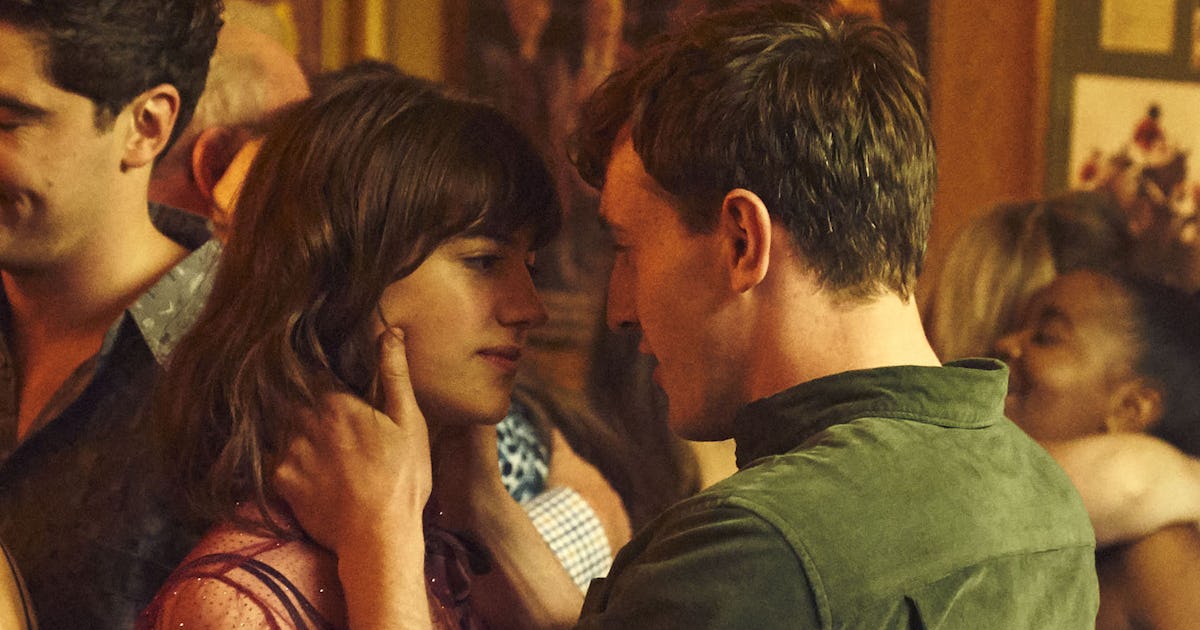
These New 'Normal People' Pictures Give Us A Glimpse Behind The Scenes

The plot. The transition in this novel from secondary school to university was written so beautifully. For most people, this is the time in our lives where we really change. Some grow up, some get left behind, and some evolve into a completely different version of themselves. Rooney makes an amazing commentary on how we allow ourselves to be restrained by the opinions of others, before realising that the only opinions that matter are those of the people we love. Connell and Marianne were both flawed, but their ability to love each other despite these flaws was what made their story so special. 

I think every English student can agree that the depiction of Connell’s seminars was painfully spot-on. So much so, it felt like Rooney must have sat in on one of our own classes at some point. The university discourse: the self-discovery, the angst and the independence was told brilliantly through Connell and Marianne’s arguably different experiences. To see the two almost switch places from high school to university highlighted that who you are in school does not define who you are for the rest of your life. For me it raised the question of: do we ever really know who we are? Or is life all about the unpredictability of it all? 
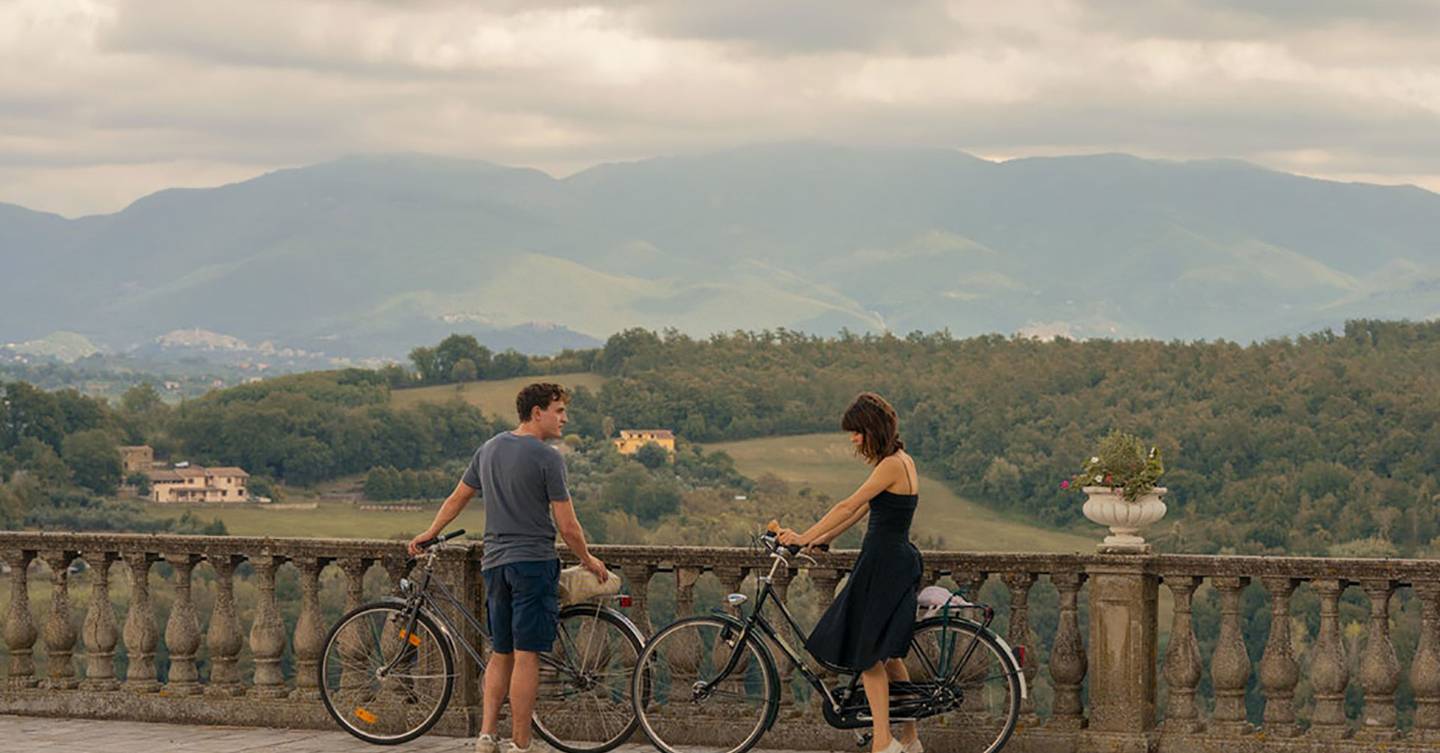
BBC's 'Normal People' Filming Locations – Ireland, Italy and Sweden | Tatler

The multiple misunderstandings between Connell and Marianne, while becoming somewhat of a running joke, were poignant in explaining how modern human relationships can be so complex. In a time where social media can trap us in an endless cycle of gossip and painful comparisons, we are reminded that sometimes the only way to hear the truth is if we sit down and talk about it. Reputation, gossip, pride and bad timing were some of the reasons that Connell and Marianne parted ways over the years. However, what always brought them back together were their raw and honest conversations that they weren’t able to have with other people.  

After I read the last page of the novel I tiptoed to my housemate’s room to lend it to her, and then I went to sleep. It was the following afternoon when I felt compelled to go back to that last page and read it all over again. I had a sudden, overwhelming feeling that I wasn’t done with the characters, that I needed to make sure I really understood what I had taken from the novel’s conclusion. This is what I found: Normal People is a book about two teenagers who become entwined in each other’s lives as they make the tentative journey from childhood to adulthood. It’s about how we, as individuals, don’t always realise the impact we have on others. It’s about how Connell and Marianne ended up helping each other more than they could have ever realised, and how they both gave each other something completely invaluable. Ultimately, it’s about the fact that even if things are bad for weeks, months, or maybe years, it does not mean they will be bad forever. The loudest thing that Rooney’s captivating Normal People said to me was this: With the help of the people who truly love us, we will be okay. 
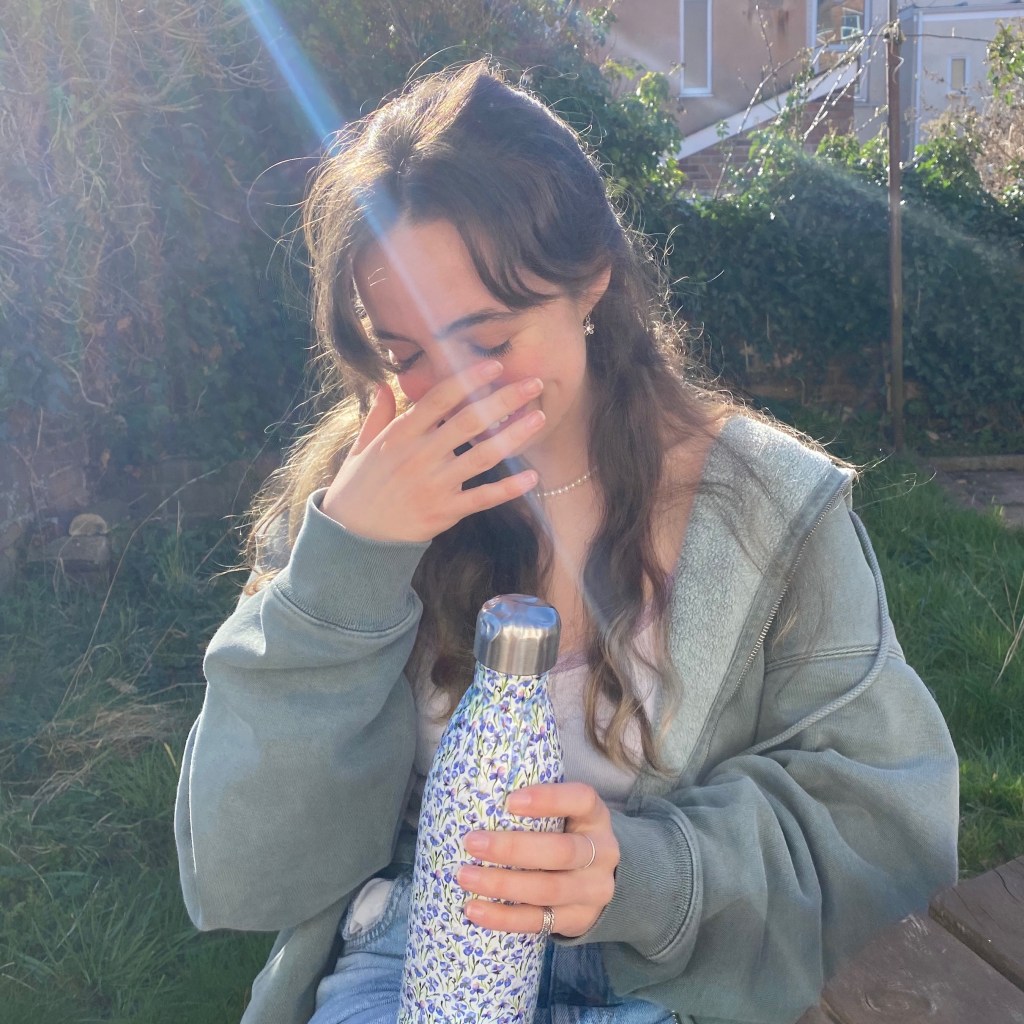
The art of spending the whole day outside (from the viewpoint of a 20-something uni student)

The art of spending the whole day outside (from the viewpoint of a 20-something uni student)

I think I can probably speak for everyone when I say that this past weekend was the warm embrace that we all so desperately needed. The overcast skies and disappointing temperatures had been going on for so long that my housemates and I had resided in the fact that this was just our life now. So, when the grey cleared and the sun proudly returned to our skies, we couldn’t quite believe it. With the additional news of the ‘roadmap’ (how sick are you of that word?) out of Covid-19, it was like the imminent spring was saying to us ‘did you really think I’d let you down?’. Granted, spring doesn’t officially start until March 20th, but the glimpse we got this weekend was enough to keep us going for now.

On Friday we began the three-day hiatus from our work and impending dissertation deadlines, which we discarded along with the winter coats we had now shoved back into our wardrobes. It seems as though lockdown has really made us appreciate the simplicities of basking in the sunshine, even if all the shops and restaurants around us are closed. We visited the nearby seaside town of Topsham and marvelled at all the people just sitting and watching the world go by, and we were more than happy to join them. For the first time in a few dreary months, our heads were clear and we let ourselves soak in the moment (and the warmth). We wandered around the town for a few hours, appreciating the fact that pretty places like this were on our doorstep. A little hole in the wall sold fresh ginger beer and slices of cake, which I was I was more than happy to indulge in. The only thing I slightly regret was scoffing my cake before we realised we would have to make a run back up the hill for the train. Saturday consisted of a few wine hangovers and an attempt to watch the sunset, before being turned away due to the controlled explosion of a WWII bomb in Exeter (never a dull moment). Nonetheless, on our return, we decided to sit in our garden until the sky turned dark and the chill crept in.

On Sunday, we spent the entire day outside. Of course, this isn’t exactly ground breaking, but there was something so funny about the fact that we really hadn’t planned to do so. The curtains in my uni room are behind my bed, and so every morning I reach back and tug at them to reveal what the weather has in store for me. If it’s grey, I feel no haste to get up, but if it’s blue, I feel guilty for staying in bed a moment longer. On Sunday there wasn’t a cloud in the sky, and so I began the first shift of the day before 10am – eating my breakfast outside. It wasn’t long before I was joined by the rest of my housemates and we spent the morning putting the world to rights. Sleepy, but hopeful, we seemed to set the tone for the rest of the day. I escaped inside to shower and dress, with the view of doing a little bit of work, but I stuck my head out of the window and discovered my housemates were unmoved, and so I had no choice but to rejoin them. We continued like this for hours, popping inside for only a moment until the pull from outside overwhelmed us again.

All day long we sat and told stories and laughed and suddenly nothing seemed quite as bleak as it had been. Eating breakfast and lunch outside was far more exciting than eating it in our dingy kitchen, and it tasted all the better for it. It’s funny how quickly time can pass if you’re having a good time, even when you’re having said good time doing absolutely nothing. We all had things to do in preparation for Monday, but they just didn’t seem as important as sitting around our tiny picnic table and enjoying each other’s company. At one point the temperature reached a whole 14 degrees celsius, and we collectively agreed that it was now in fact summer and nothing you could say would deter us from this conclusion. There’s nothing quite so thrilling as being perfectly warm enough in a cami and a cardigan in February. By the afternoon, the beer was out and the conversation was a little more loopy. All around us, in the vast expanse of uni house gardens, came the sound of other students doing the exact same thing as us: making the most of what we’ve got. It’s the same sound you might hear picnicking in a London park or in a busy theatre during the intermission – excitement and anticipation for the good times ahead.

It’s amazing what sunshine and fresh air can do for your mood, and I seem to be surprised by this every time. That evening, I had a few new freckles, rosy cheeks, and a happy, drowsy feeling that promised a good nights sleep. In the morning I felt like I was reset and ready to tackle the last four weeks of term. Alas, in true English fashion, the clouds seem to have returned once again, but this time I know that the sun is waiting patiently behind them.

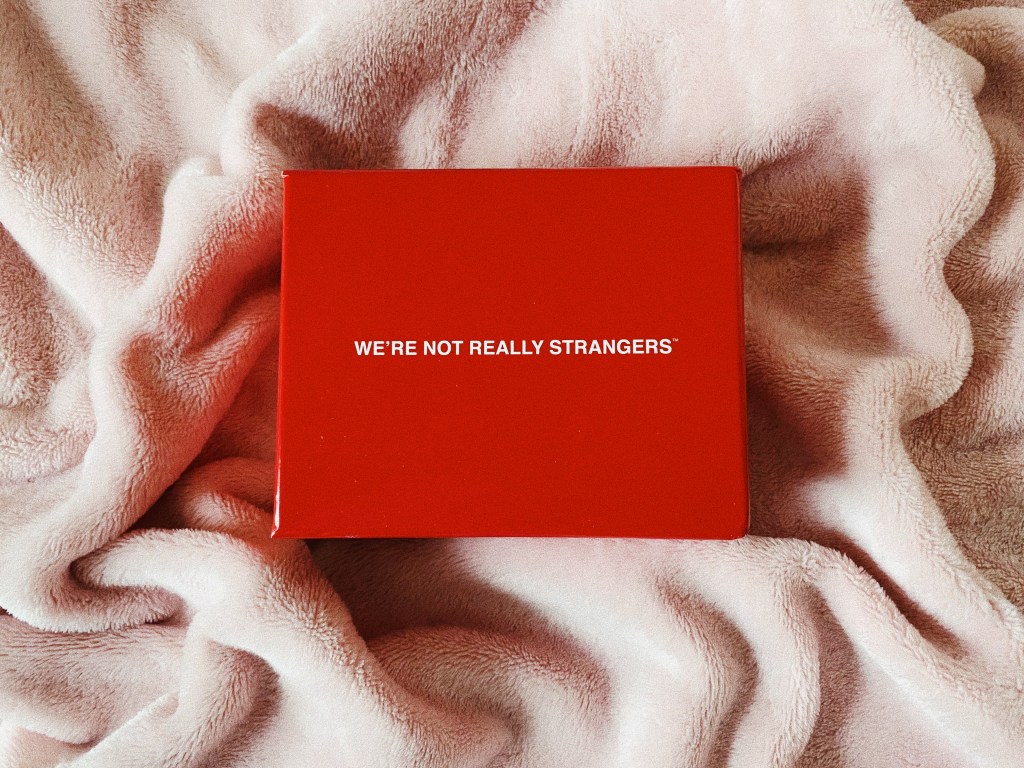
I played ‘We’re Not Really Strangers’ with my housemates

I played ‘We’re Not Really Strangers’ with my housemates

Sharing. It comes naturally to some, but others find it absolutely terrifying. With sharing comes vulnerability. As soon as we talk about our feelings, they no longer exist inside the privacy of our own minds – we release them for others to comprehend and interpret. Sometimes the things we share can fall into the wrong hands, and then we kick ourselves for being so naïve. However, it is only a matter of time before our guard comes down again and we share once more. Whether you like it or not, it’s human nature, and most of the time, sharing does a whole lot of good.

We’re Not Really Strangers is a card game designed specifically to promote open and honest conversation, helping people to connect with one another. I first discovered the game through their Instagram account, which has over 3m followers. The page shares thought provoking questions that will inevitably make you stop and think, even if you don’t intend to. Every time I saw them, I would send them to my friends who would either shy away or answer the question. I was fascinated by the concept and was desperate to get my hands on the game, which is why I was very happy on Christmas Day when my Dad had ordered it for me all the way from the USA.

The game has three levels:

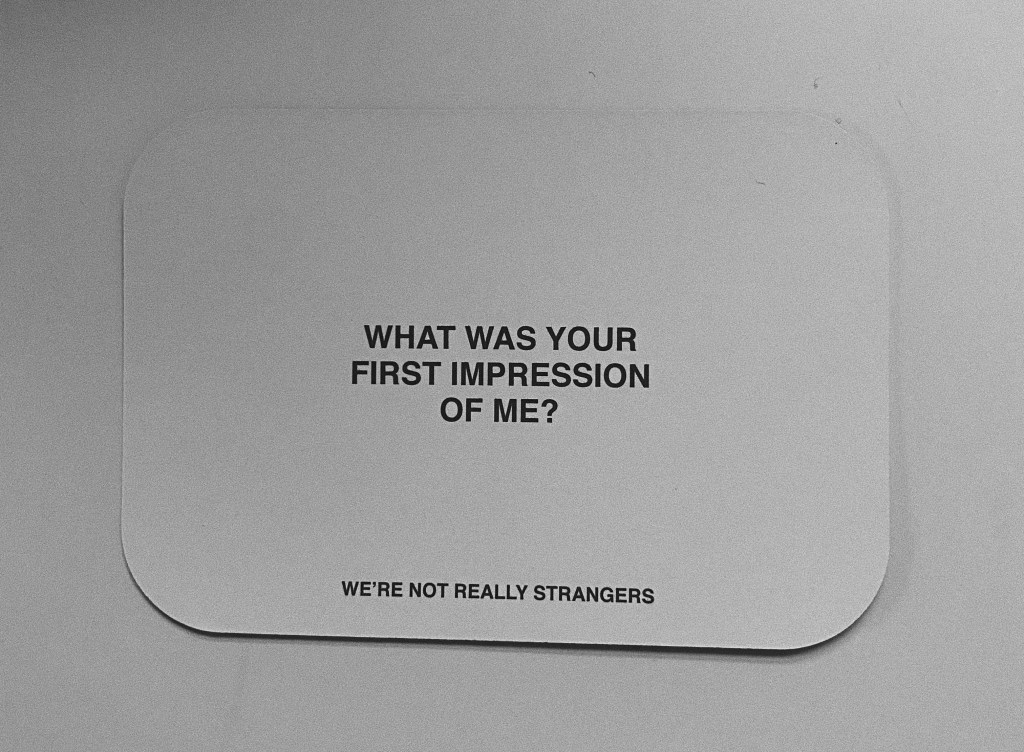
Level 1: Perception, with cards like this:

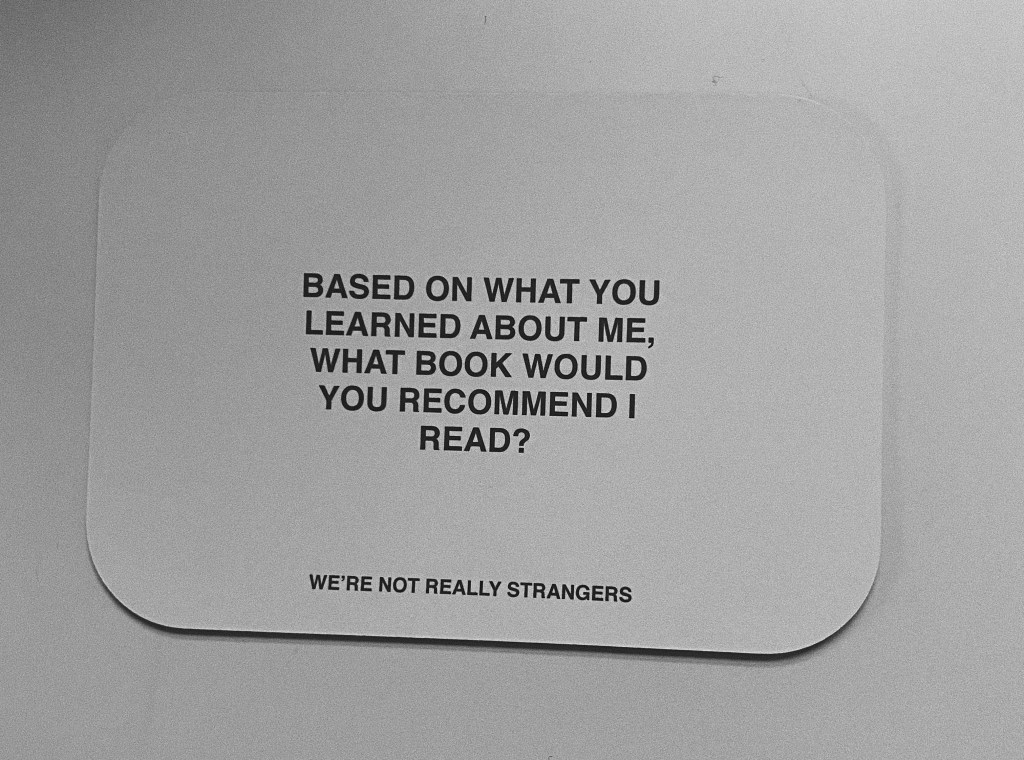
Level 2: Connection, with cards like this:

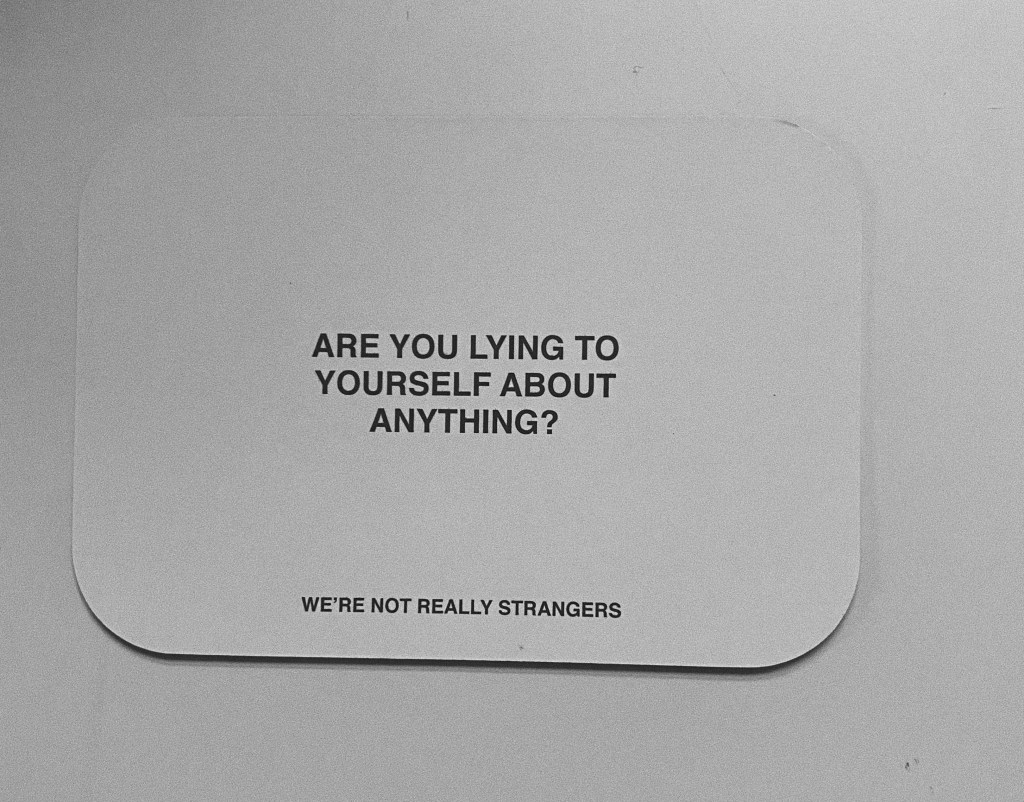
Level 3: Reflection, with cards like this:

Essentially, each level gently progresses to make the sharing relaxed and natural. There is no pressure when playing – you can interpret the questions however you see fit, and reveal as little or as much as you like. Understandably, as soon as I received the game, I was desperate to play it with someone. I tried playing it with my siblings, but it became apparent that we knew each other far too well to have any new or profound conversations!

Back in Exeter, for a locked-down term 2 of my final year at university, I was suddenly presented with the perfect opportunity to play. My housemates, who I have only known for about a year, and only properly since September, were just as excited to play as I was. It was my friend’s 21st birthday, and in true lockdown style, we dressed up and got drunk together, trying to make it as enjoyable as possible given the circumstances. We were aware that once the game came out, the tone of the evening would change, and so we saved it until our feet were tired and the music switched from the Party playlist to the Chill playlist.

Before I continue, I must disclose a few things. Firstly, everyone in my house was on the same page – we wanted to play and and we wanted to share. Secondly, we knew the trust between us was strong enough to ensure that playing together was a safe thing to do. Finally, there was a mutual air of respect and compassion in the house, which presented us with the best environment for our first game.

I think we must have started playing at about 1am. Level 1 was really interesting. The game is designed so that you could play it with a stranger, therefore there are many questions like the one shown above. In this round, you ask the question and other people answer it about you. It was fascinating to hear our first impressions of each other, and wonderful to see how those impressions had evolved and changed as we’d got to know each other. This year at university we have spent more time in our student houses than any year before. Although it’s been strange and completely different to how we thought our final year would be, it hasn’t been all bad; we’ve got to know each other on a deeper level that we may not have otherwise had the chance to. Instead of rushing off to campus all the time, or going out clubbing on different days of the week, we’ve been around each other constantly, and it’s definitely improved our communication. The game isn’t all serious, some of the cards inspire silly stories and general observation, and therefore we were laughing as we went along.

Level Two is a step up, as you pick the card and then decide who to direct the question at. This round inspired us to share things that you wouldn’t normally think of sharing around a table, but in the moment we felt very comfortable and it wasn’t weird at all. We cried and we laughed and we discovered things about each other that perhaps we hadn’t known before. What’s also great is just because one person answers the question, it doesn’t mean that the focus is on them the whole time. More often than not, we would go off on various tangents for 20 minutes or so, all sharing stories about the wonderful and difficult parts of our lives. There’s something so special about a group of people listening intently to one another without the need to interrupt, and instead naturally weaving our responses around every story. Empathy was high, compassion was high, and therefore the energy in the room was quite special. I understand that you might be reading this and wondering what on earth I mean, but if you’ve ever had a conversation with someone where you felt like you were both being 100% honest, you’ll know the exact feeling I’m talking about.

Of course, talking can be exhausting and sharing personal things about yourself requires a lot of energy. By about 3am it was clear that the conversation had drawn to a natural close, and we felt it would be unnecessary to move onto Level 3 when the experience had already been so cathartic. We put the cards away and agreed to play again in a few weeks time, after deadlines and the stress that comes with the beginning of a new term. We each went to bed that night feeling sleepy, happy and renewed after a fun evening.

For me, sharing comes quite naturally. I’ve never been able to conceal my emotions and I always feel better after releasing them. There have been times where I’ve wished I kept my mouth shut, and there are people I regret sharing with, but ultimately I believe that sharing helps to keep me grounded. I once read a quote about the fact that our friendships and relationships can only progress when we share personal things with each other, and I really think this is true. To be able to be vulnerable around someone is to allow them to see the most wonderful parts of ourselves. Even if it seems scary, it’s so good for your mind and wellbeing to not keep your thoughts cooped up all the time.

Perhaps you’ve read this post and considered your relationship with sharing, or perhaps you’ve decided you prefer your life as a closed book. Either way I want to leave you with this, to interpret as you wish: What do you feel it is that’s holding you back?

A Love Letter to the Cinema

A Love Letter to the Cinema

I haven’t been to the cinema in 10 months. The last time was to see Emma (2020), just weeks before all public establishments, including cinemas, were forced to shut. Most films went straight to VOD or had their release date pushed back, and so many promised films were halted mid-production. I remember initially hearing in March that the James Bond premiere was being postponed until November, and thinking how ridiculous this seemed – but now I wouldn’t be surprised if it was pushed back even later than it’s provisional April 2021 release date. With my longing for the cinema growing as each week passed in a blur, I began to think about just why I missed it so much. This is my love letter to the cinema.

I can link so many different times of my life to the cinema. First, there were the films that my Dad took my siblings and me to when I was little (probably to give my mum space to breathe on a Sunday afternoon). I famously cried during Pooh’s Heffalump Movie (2005) and demanded that my dad take me home at once, on account of the Heffalumps being absolutely terrifying. I was also tricked into seeing March of the Penguins (2005) at the grand age of six, obviously not realising I was expected to sit through a documentary with real penguins and not a cartoon bird in sight. We saw many amazing films too, but of course it was the letdowns that stuck with me. However, it didn’t matter if the film was disappointing, because going to the cinema wasn’t just about what played on the screen. It was the excitement the night before, the ridiculous amount of pre-purchased sweets we would conceal in our coat pockets, and the promise of a McDonald’s happy meal afterwards. A trip to the cinema had the ability to create a buzz like no other. 

When Mamma Mia! (2008) came out, it did so well that it was given an extended run in the cinema. One rainy school Inset Day, my mum took my sister and me to see it, months after most of the country already had. All seats inside the screen were empty, apart from ours. We enjoyed it so much (obviously) that we spent the rest of the day singing the soundtrack and in disbelief that we hadn’t seen it earlier. It was a wonderful day. That same year, my aunt and uncle took me to the High School Musical 3 (2008) premiere in Leicester Square. The day at school seemed to drag on for hours and hours, and I remember feeling the same excitement you would get on the morning of your birthday party. It was my first experience of seeing how influential a film could be, and while I apologise that my example has to be HSM 3, the atmosphere on the red carpet and inside the cinema was magical to nine-year-old me. 

The cinema in my town is an Everyman, a gorgeous (if not a tad overpriced) boutique cinema. With plush velvet seats, a bar and restaurant, with the option to have food and drink brought to your seat, it’s a favourite spot of mine. As I got older, I realised that the staff in smaller chain cinemas are usually big fans of the big screen as well. Especially the kind of cinemas that prove they really care about your cinema-going experience. I started to love chatting to the employees behind the ticket desk, sharing my anticipation for the film and hearing their vague-as-to-not-give-anything-away-but-promising reviews. I once expressed my frustration that I had never been able to cry at a film, while the boy serving us promised that I would at The Fault in Our Stars (2014). He was right – my friend and I left with tears streaming down our faces, laughing at the fact that we thought we’d prove everyone wrong. I’ve seen the film enough times now that it doesn’t have that tear-jerking effect anymore, but I can still remember the way I felt the first time. That film seemed to be the catalyst for me, as I’ll cry at just about any film these days.

There are cinema trips I remember for the people I went with, the occasions I went for, the location of the cinema, or the way I was feeling at that point in my life. When my friend and I spent a month in Los Angeles, we went to the cinema at The Grove to see Game Night (2018). There was something incredibly American about it; the loudest laughter I’d ever heard, the biggest buckets of popcorn and the largest cups of soda. It felt surreal to be so far from home, in a setting that was so familiar but felt so different. I saw A Star is Born (2018) twice on the big screen, within weeks of each other. I knew that the second viewing would be just as amazing, if not more, than the first. I wasn’t particularly happy at that time, but for those few hours I was content. My surroundings were entirely enveloped in brilliant acting, beautiful camera shots and wonderful music. It’s about the sense of belonging too. There’s something so nice about laughing with everyone else in the room, gasping when no one saw it coming, and crying when the best or worst happened. When Timothée Chalamet first appeared on screen in Little Women (2019), there was an audible intake of breath and tiny squeals all around me (including my own). I find the cinema to be a place where, for the duration of the film, we’re all experiencing the same thing for the first time and feeling the same emotions. It connects us to one another despite our differences. A few times I’ve been one of the youngest members of the audience, but when the lights are dimmed this doesn’t seem to matter. 

There’s a running joke about the way you can walk out of the screen at the end of a film and feel as though your life has been transformed. I think this is telling of how special the cinema can be. To be immersed in this world for just a short amount of time but to feel inherently different afterwards – that’s a pretty amazing feat. We all know the feeling of leaving the cinema late at night and how it seems as though we’re the only ones still awake, and I think this makes us feel a personal connection to the mutual experience we all just shared. 

Let’s go back to my most recent cinema trip. It was February 2020 and I was going to see the Emma remake. It was a cold but pretty evening, and my best friend and I walked there together. I’d read the book and seen the 1996 film starring Gwyneth Paltrow, so I was excited to see what they had done with the story I already knew so well. The staff were lovely, as always, and just before the adverts started, the G&T I’d ordered was brought to my seat. As cinema trips go, it was a pretty perfect one. The film was grand, the company was grand, and I left with a warm and happy feeling in my tummy (although that could have been the gin). I didn’t know then, of course, that this was to be my final big screen viewing of a year that had only just started. However, in hindsight it couldn’t have been a more fitting last hurrah. 

As the New Year arrives with the promise of the vaccine, I feel we are allowed to, cautiously, look forward to a sense of normality. For me, the hope of finally returning to the cinema is high on my list. After a year of watching new films in my sitting room, with the distractions of mobile phones and family members talking in the other room, I long to go back to the screen. It may seem like a novelty, but it’s absence reminded me of how much I love it. I miss going on a Sunday night in what might as well be my pyjamas, or on a Friday evening in a pretty top, with the promise of dinner reservations afterwards. I want to snag the final available seats for a film during it’s first night on screens and I want to buy the most incredible, and expensive chocolate buttons that the cinema has to offer. What I’ve realised, or perhaps what I always knew, was that going to the cinema isn’t just about the film. It’s about the environment, the people, and the experience that doesn’t seemed to be mirrored anywhere else. 

On getting better

On getting better

It’s been a little over a month since my first post on this blog about my battle with anxiety. I wanted my second post to come a little sooner than this, but unfortunately I am a serial procrastinator (which isn’t the best habit to pair with a love for writing!). However, here I am once again to plague your screens with a few too many words.

To say I wasn’t expecting the response I received would be an understatement. When I considered writing about my experience, my main focus was ‘Who will this help?’. I didn’t want to publish something that people couldn’t also find a bit of themselves in. Of course, in part it was a release for me to get it all out on a page, but ultimately I wanted to write something that would make other people feel less alone.

In the following days from hitting publish I was on the receiving end of some amazing messages. Some from friends, some from acquaintances, and some from complete strangers – each of them just as meaningful as the rest. I found myself in this incredible bubble of honesty and bravery, with so many people sharing similar stories with me. It made me realise that the assumptions we make of people from their online presence can be so far from the truth. You really do never know what’s going on in someone else’s life, and I think a lot of us forget that sometimes.

I cannot, and would never claim to, know how it feels to live with mental health battles outside of my own, when the two main things I have suffered from are grief and anxiety. However, I think there is a universal truth to be taken from the hardships we may face.

When you are unhappy in life it can be so hard to picture yourself in a time where everything feels good again. I have experienced bouts of unhappiness that stem from obvious reasons, but also some where I cannot understand what it is that’s making me feel this way. I’m sure we’ve all seen old photographs of ourselves and thought either ‘I was so happy then’ or ‘I was so unhappy then’, yet we can’t pinpoint an exact moment between then and now that things changed.

That brings me to getting better. When my anxiety was unbearable, all I could see was a wall separating me from the life I wanted to live, and the one I was currently living. To scale the wall seemed impossible and I nearly resigned to the idea that this was how it was going to be from now on. I’m sure when Alex Honnold first glared up at El Capitan he couldn’t imagine making it to the top, yet in 2017 he was able to climb it without so little as a safety rope. Getting better is about trying and failing, trying and succeeding, making changes, but also remaining consistent. My point is that there’s no one way to do it. Suddenly we are nearly 7 months in to 2020, a year that has not turned out how any of us could have ever conceived, yet I find myself in the best place I’ve been since the New Year. I respected that I needed time to love and look after myself, and in turn, I found a way over that wall without even thinking about it.

Sometimes you might find yourself taking two steps forward and one step back – but that doesn’t invalidate the one step forward that still occurred. It is ludicrous to think that we can be so kind to others, yet so cruel to ourselves. After all, you are the one person in your life that can offer yourself unconditional kindness whenever you may need it. As always, I want to repeat how important it is to talk to someone, and if you feel like you’re at the bottom of that terrifying wall right now, I can promise that you’re about to find your first foothold.

– LS

I never knew how debilitating panic attacks could be until I had one

I never knew how debilitating panic attacks could be until I had one

If you had told me on New Year’s Day that I was about to experience the worst wave of anxiety and panic attacks I’d ever had, I wouldn’t have believed you. In fact, it was the first New Year’s Day in the three years since my mother had died that I hadn’t felt angry at the world. Usually, New Year’s Day was just a reminder of another year of my life that I would have to live without my Mum. Another year that she would never see. This time, however, it was different. I finally felt like my world had calmed down after a turbulent year. I’d successfully transferred straight into second year at my dream university, Exeter, having had a miserable first year at a university in East London. I had good friends at uni and at home, and I was looking forward to returning to Exeter after the Christmas holidays. So, as I sat there in my dressing gown on January 1st, surrounded by some of the people I treasured most in the world, I felt happy. I didn’t care that I was running on four hours sleep, or that my body was paying for all the prosecco I had consumed the night before, I was just content to be there.

I caught a cold (most likely a result of the back to back Christmas drinking) and felt pretty groggy for the next few days. One afternoon, I was due to head up to London with my friends but I was struck with the strongest desire to stay at home in my pyjamas. I put it down to the fact that my body was still recovering from the cold and didn’t think anything of it – we rescheduled and that was that. Until the exact same thing happened again. Only this time I had got dressed, done my hair and put on my makeup, yet something wasn’t letting me out the door. In fact, a full on panic came over me; the thought of being on a train for half an hour, or walking around London, or sitting in a restaurant feeling like this was enough to scare me back to the safety of my sofa.

It turns out this was the beginning of an intense period of anxiety, agoraphobia and panic attacks that was about to screw up the start of my year. As the days went on it only got worse. I was terrified to leave the house, I would lie awake in bed for whole nights at a time, and I was experiencing panic attacks in the safety of my own home which is something that had never been an issue before. Every morning I would wake up with the same cloudy feeling in my head. My aunt had to drag me (quite literally march me out the house) on a walk to get some fresh air, but I had to cling tightly to her arm the whole time. It was hell. I missed the first week back at uni because the thought of being anywhere but my own home filled me with dread. Eventually, after finally getting a decent night of sleep, my Dad drove me down to Exeter as I sat timidly in the front seat. When we got there I realised I couldn’t even go into the supermarket to get some food for the next couple weeks – I had to send my Dad in alone while I cowered in the car. Although getting down to uni felt like I was over a huge hurdle, it became clear that this was only a small step forward.

The next few weeks were pretty miserable. Mundane activities, such as popping to the Co-op, felt like impossible tasks. My wonderful housemates would walk everywhere with me, close by so that they could jump in to help me at any time. Public spaces overwhelmed me and I felt out of control. Supermarkets felt so bright and busy that I was sure I would topple over and faint at any given moment; I would rush around furiously grabbing the groceries I needed, desperate to buy them and run back outside to the fresh air. A long queue was unbearable and I would always feel the panic rising in my chest as I had no choice but to stand there and wait. I gave up iced coffee, which was my absolute favourite thing to drink, and stayed away from anything else with caffeine in it. There was no chance I was going out clubbing either, so I stopped drinking alcohol.  Even the cinema was too much for me. As a result, my social life was pretty much put on hold, which wasn’t the best thing considering I was pretty new to Exeter.

One morning, by some miracle, I felt brave enough to attempt going to a lecture. Everything was going swimmingly until half way through I felt the unmistakable signs of a panic attack starting. It didn’t make sense – I had felt so calm the whole morning. It felt like it took every atom in my body to stay in my seat for the rest of the lecture – I feared that if I stood up I would faint or throw up and wouldn’t even be able to make it to the door. After this, I didn’t attend any classes for the rest of the term. Some days I would get all the way to the entrance of campus before turning on my heel and rushing home again. My fear of having a panic attack in a lecture or seminar was overwhelming and I let it take control of my life.

I want to pause here to describe what my panic attacks feel like. For me, they begin with a sudden hyper awareness. I start to notice every small detail around me and it feels like space is closing in on me. I can feel my tongue heavy in my mouth and I get this overwhelming sense that I can’t keep myself upright. Soon after, my heart begins to thud in my chest (from the fear, of course) and my breathing becomes heavy and irregular. Whatever situation I’m in, I have to get out of it. Be it a supermarket, a train, a restaurant, or just a sofa crammed with people. I can’t concentrate on anything and I feel sick to my stomach, despite the water I’m sipping desperately to calm me down. Usually the worst of it is over in about 10 minutes, but sometimes they can last up to an hour. Everybody who suffers from panic attacks will most likely have slightly unique experiences. Some people experience physical pain symptoms similar to a heart attack and while I have never had to deal with that, I can only image how terrifying it can be. Essentially the fear associated with panic attacks is that you convince yourself you’re going to die, because there’s sometimes no logical explanation why it’s happening. No matter how much you tell yourself this, when you’re in the middle of one, the fact becomes futile.

It got to a point where I really couldn’t imagine myself getting back to normal, but I was lucky enough to have the right people around me to pump me full of hope. The truth is, the worst of it only lasted a month. Of course, when you’re stuck inside all day, doing nothing for a whole month (as I’m sure many people can relate to at the moment), it feels like forever. I didn’t feel like I was making any progress, but then I began to look back and realised there were things I was suddenly able to do which I couldn’t face doing the week before. I would have less mornings with a cloudy head, and more where I was happy to jump up and grab an early shower. My bedroom at uni had a door leading into the garden, so I would eat my breakfast outside whenever I could, just to appreciate how good the fresh air felt.

I started taking CBD capsules once a day, and whether it was a placebo or not, I noticed the difference. I stopped being so scared of being in public and I even managed to go out for breakfast. Although it was such a tiny step, I was so pleased that I had sat through my meal without wanting to escape. It’s important to notice the victories, regardless of their size. My friends were so understanding and always made it clear they wanted me to communicate how I was feeling. It’s so important to laugh too. We had a joke that you would know what sort of mood I was in depending on how long I would spend in a supermarket. If I rushed around like a headless chicken, they knew they had to get me home as soon as possible, but if I took my time it meant we could stay out in town and have a laugh as we browsed through the sale section in Topshop. I can’t stress how important it is to talk to somebody. I found that just emptying my thoughts out to someone other than myself lifted some of the burden my anxiety was on me. I spoke to the university mental health team and I sought professional help from a CBT therapist and began to realise just how many people are waiting with open arms to help you. Even when I finally saw a doctor and told her “I think i’m suffering from severe anxiety and panic disorder”, I noticed how her just agreeing with me felt like a huge sigh of relief that this wasn’t all in my head.

At the end of February I came home to go to a concert in London with my sister. I was nervous, of course, but even getting ready and going to the train station felt so good and normal. We had a few tins of g&t on our way up to town and this loosened me up before the big and scary underground at London Bridge. When we got to the platform of the tube I was worried that the dizziness I felt was an anxiety attack about to hit. This was until my sister turned to me and said ‘Do you feel a bit light headed?’ at which point we burst into laughter because it was clearly just the alcohol. I looked at all the people on the tube and thought about the fact that none of them knew how chuffed I felt to be crammed on there with them. I think that says a lot about anxiety. It’s such a personal, interior battle, that no one apart from yourself can truly comprehend it unless they’ve experienced it themselves. But this doesn’t mean people aren’t willing to listen. Before I had my first real panic attack in my first year at university, I never really understood how prohibiting they could be. I felt sorry for people who said they experienced them, but I couldn’t quite grasp what could be so scary about it. It’s so important to understand that invisible struggles and mental health problems are just as valid as physical health problems and I only really realised that when I began to suffer from it. I’m sure that among those commuters on the tube were many different people who were going through something that you couldn’t tell by looking at them, just as they didn’t know how much of a triumph it was for me to be there. The concert was great, by the way.

From that point forward I only got better. I went to a friends 21st birthday and had a super fun evening free from worry, even if I did pay for it with the hangover the next day. I figured I was going to have to cancel on the day of, but just like so many things, the anxiety began to leave as quickly as it had arrived. I was also able to go to a crowded pub with my family and do nothing but laugh the whole evening. The happiest part of it all was that I finally felt brave enough to go to the cinema, and it was grand.

The truth is, this bad spell of anxiety didn’t come out of nowhere. I’d been ignoring the signs since the summer and just hadn’t dealt with it. I’ve always been an anxious person, but it was never as prominent as it has been the last few years. I thought I could manage it fine just by myself, but anxiety doesn’t work like that. There were times where I felt a little strange in supermarkets but because it wasn’t happening consecutively, I just pushed it away. I even stopped driving for a while at the end of summer because I’d had a panic attack in my car on my way back from brunch with friends, but I pretended this was something I could just get over. With these things, they rarely go away unless you confront them head on. I had my fair share of arguments with my best friends when I dismissed their concern and told them they shouldn’t be worried, but they were right: I needed help. I’m so glad I finally listened.

I still have a long way to go. Although I have taken back control of my life, I have days that are better than others and sometimes I still can’t face going to the supermarket. The difference now is that I am filled with nothing but hope that as time goes on I will only get stronger. I just want to take a moment here for anyone who might be going through the thick of it right now: it will pass. It’s going to feel like shit for a while, but as the saying goes, after every storm comes a rainbow. I cannot repeat enough how important it is to talk to somebody, and how vital it is that you are kind to yourself. You are not alone. I have the most incredible family and friends in the whole world, and they never make me feel like my anxiety is a burden. I am met with nothing but patience and love and that’s all I need in my life. Surround yourself with people who encourage you to talk about your feelings and don’t ever think that it would be better just kept to yourself. It is not something to ever feel ashamed of. Fill your time with things you enjoy doing and let yourself rest if sometimes it all seems too overwhelming.

I was inspired to write about my experience by some of my gorgeous friends that have been open and honest about their mental health even when it seems so scary to do so. Whether this was privately or publicly, just talking about it makes a world of difference. You know who you are, and I love you so much.

– LS